Why do AI detectors give different results on the same text?
Short answer
Because each detector is a different model with its own threshold: in Weber-Wulff and colleagues' 2023 test of 14 detectors on the same 54 documents, false positive rates ran from 0 percent (Turnitin) to 50 percent (GPTZero) and false negative rates from 8 to 100 percent. Paraphrasing widened the gap, and some tools changed their answer between runs.
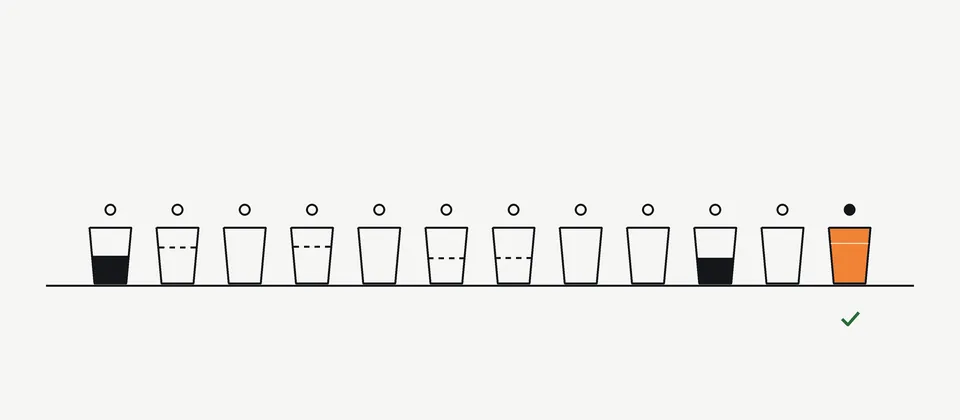
Because each detector is a different model with its own threshold: in Weber-Wulff and colleagues' 2023 test of 14 detectors on the same 54 documents, false positive rates ran from 0 percent for Turnitin to 50 percent for GPTZero. That is the short answer to why do AI detectors give different results, and the rest of this guide is the evidence behind it: the published per-tool spread from that study, what the detector families measure, why paraphrased text widens the gap, and how the published method on this site reports disagreement instead of hiding it. Whether detectors work at all is the sibling question, answered on the detector accuracy guide.
How far apart were the detectors in the published test?
Weber-Wulff and eight colleagues from the European Network for Academic Integrity wrote 54 documents in six classes, from human text never exposed to the internet to AI text paraphrased by QuillBot on its default setting, and ran every document through 12 free detectors plus Turnitin and PlagiarismCheck between March and May 2023, 756 tests in all (Weber-Wulff et al. 2023, International Journal for Educational Integrity, read 9 November 2026). The figures below are theirs, and every one is a 2023 reading on the model each vendor served that spring.
| Measure | Lowest tool | Highest tool | Across all 14 |
|---|---|---|---|
| Overall accuracy | Below 70 percent for 9 of 14 tools | Turnitin, then Compilatio and GPT-2 Output Detector | None reached 80 percent; 5 passed 70 |
| False positive rate on human text | 0 percent for 7 tools, Turnitin among them | 50 percent, GPTZero | 6 of 14 produced false positives |
| False negative rate on AI text | 8 percent, GPTZero | 100 percent, Content at Scale | About 20 percent of AI texts read as human |
| Unedited AI text caught | 13 of 14 missed at least one document | Turnitin caught all 18 | Overall accuracy 74 percent |
| Machine-paraphrased AI text caught | Overall accuracy 26 percent | ||
| Human text machine-translated to English | Accuracy fell 20 points from 96 percent |
Read across one row and the disagreement is plain. GPTZero was the only tool that leaned toward calling text AI, which gave it the lowest miss rate and the highest false accusation rate at once; Content at Scale called everything human and missed every AI document. The same text, sent to those two tools on the same day, came back with opposite answers, and both tools were behaving as designed.
Why do AI detectors give different results on the same text?
Three things differ between any two detectors: the model, the data it learned from, and the line it draws between human and AI. Wu and colleagues' 2025 survey in Computational Linguistics sorts the field into watermark detectors, statistics-based detectors, neural classifiers and human-assisted methods, and lists the open problems as out-of-distribution text, attacks on the detector, messy real-world data and the lack of a shared evaluation framework (Wu et al., A survey on LLM-generated text detection, arXiv 2310.14724, read 9 November 2026). Two tools from two families are not measuring the same thing, so they have no reason to agree.
| Detector family | What it keys on | What moves its reading |
|---|---|---|
| Statistics-based (perplexity, burstiness, token probability) | How predictable each word is to a reference language model | Word swaps, sentence reordering, a different generator than the reference |
| Neural classifier | Patterns learned from a labelled set of human and AI text | Text unlike the training set: new models, new genres, non-native English |
| Watermark | A hidden statistical signature planted at generation time | Paraphrasing, translation, or text from a model with no watermark |
| Retrieval | A match against a stored log of generated outputs | Any edit that breaks the match, or text the provider never logged |
The threshold matters as much as the model. Weber-Wulff and colleagues scored the tools under four approaches, one of which treated a reading as correct only above 80 percent confidence and another above 60 percent; the scores changed and the ranking almost did not, which means the thresholds decide how often a tool is "sure", not which tools are better. A vendor that moves its threshold changes every reading without changing its model. What each family actually measures is covered in detail on the detector measures guide.
Why does paraphrased text widen the gap?
Because paraphrasing pushes text toward what each model treats as human by a different amount. In the 2023 test, overall accuracy on unedited AI text was 74 percent, on AI text a person edited with synonyms and reordering 42 percent, and on AI text paraphrased by QuillBot 26 percent, so most paraphrased AI text read as human and the tools that still caught it were not the same tools that caught the originals.
Sadasivan and colleagues stress-tested detectors the way an attacker would. Their recursive paraphrasing attack, run on passages of about 300 tokens, cut detection rates across watermark-based, neural, zero-shot and retrieval detectors while only slightly degrading text quality in many cases, and they showed that an attacker could infer a watermark's signature without access to the detector and use it to make human text read as AI (Sadasivan et al. 2023, arXiv 2303.11156, read 9 November 2026). Their theoretical result ties the best possible detector's performance to how far apart human and AI text distributions sit, which shrinks as models improve. A humanizer is a paraphraser with a purpose, so every finding here applies to humanized text directly.
Does the same detector give the same result twice?
Not always. Weber-Wulff and colleagues expected two sets of AI documents prepared the same way to score the same, found that the OpenAI Text Classifier and DetectGPT gave notably different results on them, re-uploaded documents to check, and got different values again; they attributed the change to the tools, not to their testing. The study did not measure replicability systematically, and the authors called that inconsistency another strong reason against using a detector as the single source of an accusation.
| Source of change | What it does to a reading | How to record it |
|---|---|---|
| Model update by the vendor | Every past reading becomes a reading on a retired model | Date on each reading |
| Threshold change | The label flips without the text or model changing | The detector's own threshold beside the label |
| Nondeterministic output | The same text scores differently on the same day | A screenshot of the detector's own screen |
| Partial labels ("likely", "mixed") | Counted as right or wrong depending on who reads them | Record the label as shown, not a rounded verdict |
No detector score should be the only evidence in a misconduct case. The study's authors put it in their own words: reports from these tools cannot be used as the only basis for reporting students for cheating, and a student accused on that basis alone would have no way to mount a defence.
How does this site handle detectors that disagree?
By reporting the spread rather than averaging it away. The published method runs every humanizer output through five detectors no humanizer vendor owns, GPTZero, Originality.ai, Copyleaks, Pangram and ZeroGPT, and records each one's own label, its published threshold and the date, with a screenshot. Every input is scanned before any tool touches it, so the change a humanizer makes is visible against a baseline instead of against another detector's opinion, and six human-written control texts show what each detector's false positive behaviour looks like on the same genres.
Pass is counted only on each detector's own human label, per detector and pooled, and the per-detector tables show where the five disagree. Detector pass rate carries 30 of 100 points in the score; meaning kept carries 35 and errors added 20, because a rewrite that drops a claim has done damage no detector will report. The guides hub holds the rest of this series, including what detectors measure and what to do if you are flagged. Anyone writing for a class should read their institution's AI policy first; a humanizer does not make undisclosed AI use acceptable.
Sources
Questions about this guide
Why do AI detectors give different results on the same text?
Because they are different models trained on different data with different thresholds: Weber-Wulff and colleagues ran 14 detectors on the same 54 documents in 2023 and recorded false positive rates from 0 to 50 percent and false negative rates from 8 to 100 percent across the tools.
Which AI detector is the most accurate?
In the 2023 peer-reviewed test, Turnitin scored highest under every accuracy approach, followed by Compilatio and the GPT-2 Output Detector, and no tool reached 80 percent; the vendors have changed their models since, so a 2023 rank is not a current one.
Can the same AI detector give a different result on the same text?
Yes: Weber-Wulff and colleagues re-uploaded documents to the OpenAI Text Classifier and DetectGPT and got different values, and attributed the change to the tools rather than to their own testing, so a reading is true for its date.
Why does humanized or paraphrased text make detectors disagree more?
Because paraphrasing moves text toward what each model treats as human by a different amount: in the 2023 test, overall accuracy on machine-paraphrased AI text fell to 26 percent from 74 percent on unedited AI text, and Sadasivan and colleagues showed recursive paraphrasing cut detection rates across watermark, neural, zero-shot and retrieval detectors.
Should I trust an AI detector score if two tools disagree?
Treat each as one model's probability on one date: the 2023 study's authors wrote that reports from these tools cannot be the only basis for reporting a student, and no detector score should be the only evidence in a misconduct case.
How does this site deal with detectors disagreeing?
The published method runs every output on five detectors, GPTZero, Originality.ai, Copyleaks, Pangram and ZeroGPT, records each one's own label and threshold on the run date with a screenshot, scans every input before humanizing, and reports the spread rather than one pooled verdict.
Related reading
 Free AI detector and humanizer toolsFree AI detector and humanizer in one tool: 11 vendors that ship both with a free tier or trial, every limit.
 Words that sound like AI: 40 words and the plain alternativeThe 40 words that sound like AI, from "testament" and "landscape" to "underscore" and "holistic": why each.
 How we test AI humanizersThe full humanizer test: 24 AI inputs and 6 human controls, five named detectors, a meaning rubric, published.
 Do AI detectors work?Do AI detectors work? What a 2023 test of 14 tools found, what OpenAI, Turnitin, GPTZero and Pangram publish.
 How do AI detectors work? What they measure and what they missHow do AI detectors work? The four methods in a 2024 survey, what perplexity means, how GPTZero and Turnitin.