How does Turnitin detect AI? The indicator explained
Short answer
Turnitin detects AI by scoring every prose sentence between 0 and 1 with a transformer-based model, labelling sentences over a threshold as AI, and reporting the share of such sentences as the document percentage, read on its FAQ on 9 November 2026. Scores under 20 percent are hidden, documents need 300 words of prose, and only instructors see the result.
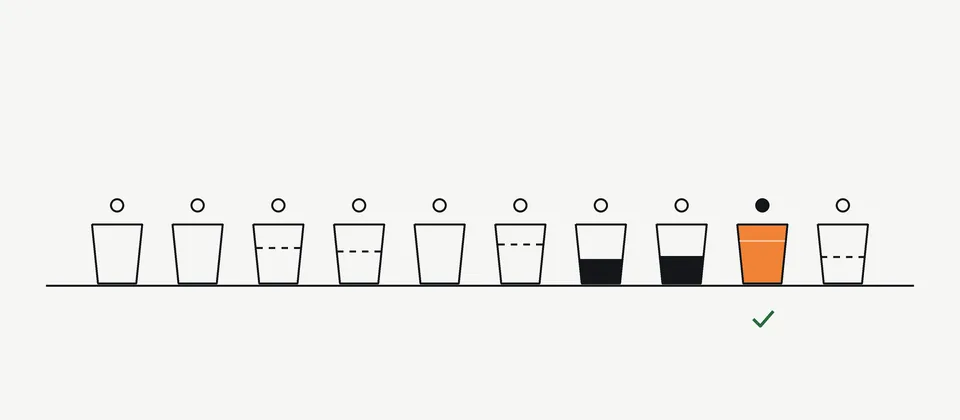
Turnitin detects AI by scoring every prose sentence between 0 and 1, labelling sentences above a threshold as AI, and reporting the share of such sentences as the document percentage, as stated on its FAQ on 9 November 2026. That is the whole mechanism behind the question "how does Turnitin detect AI", and the details around it, the 300-word minimum, the 20 percent display floor and the under 1 percent false positive claim, decide what a score can and cannot tell you. Turnitin's detector is not available to the public, so this page relies on Turnitin's published statements and on peer-reviewed studies; it reports no Turnitin result for any tool.
Check your institution's AI policy before using any writing tool. A humanizer does not make undisclosed AI use acceptable, and this site does not help anyone misrepresent authorship. If your course permits AI assistance, MLA and APA both publish disclosure formats (MLA Style Center and APA Style blog, read 9 November 2026).
How does Turnitin detect AI, step by step?
Turnitin's FAQ describes four steps, and each one removes something from the text before a number appears.
| Step | What Turnitin states happens | Read |
|---|---|---|
| 1. Strip non-prose | Lists, headers, references, data tables, formulas and code are removed; only sentences in long-form prose are evaluated | 9 November 2026 |
| 2. Check length | Documents with under 300 words of evaluated prose are not processed; files over 30,000 words are not processed | 9 November 2026 |
| 3. Score sentences | A model assigns each sentence, read in context, a score between 0 and 1 | 9 November 2026 |
| 4. Report the share | Sentences over a threshold are labelled AI; the document score is the percentage of evaluated sentences above it; scores below 20 percent are not displayed | 9 November 2026 |
Turnitin states that the document-level score "is the percentage of sentences that are above the threshold" and that it does "not display scores below 20% in the AIW report" (Turnitin, AI writing detection capabilities FAQs, read 9 November 2026). The percentage is therefore a share of qualifying prose, not of the file. A lab report that is mostly tables could show a high percentage from a few paragraphs, and Turnitin says as much: the percentage "is not necessarily the percentage of the entire submission".
In October 2026 Turnitin updated the model architecture for English submissions to improve accuracy at transition points where text changes between human and likely AI-generated content, read 9 November 2026. Scores on documents already submitted do not change unless the document is resubmitted.
What signals does the Turnitin model use?
Turnitin's explanation has two layers. The plain-language layer says language models generate "the next highly probable words" while human writing is "inconsistent and idiosyncratic", and that its classifiers are trained to detect those differences in word probability (Turnitin, AI writing detection capabilities FAQs, read 9 November 2026).
The technical layer is more careful. Turnitin states that its current system is a deep learning model based on the transformer architecture, trained on its in-house corpus of academic writing, and that it "is not explicitly programmed to evaluate specific signals such as 'burstiness,' 'perplexity,' or other individual metrics", read 9 November 2026. Its outputs come from many learned patterns together, which Turnitin says is why "individual predictions may not always be explainable in simple feature-by-feature terms".
| Question | Turnitin's statement | Read |
|---|---|---|
| Model type | Transformer-based deep learning, trained on academic writing | 9 November 2026 |
| Named signals such as perplexity | Not explicitly programmed; patterns are learned | 9 November 2026 |
| Training set | AI-generated and authentic academic writing across geographies and subjects, with second-language learners and less common subjects included to reduce bias | 9 November 2026 |
| Generators covered | Models from OpenAI, Anthropic, Google, Meta, Mistral, DeepSeek, Amazon and xAI, latest listed releases March 2026 | 9 November 2026 |
| Paraphrased or humanized AI text | In scope for English submissions; tools detected are not named | 9 November 2026 |
| Grammar checkers | Spelling, grammar and punctuation changes from Grammarly were in most cases not flagged; Grammarly's generative features likely would be | 9 November 2026 |
That design choice matters for anyone who has read that detectors "measure perplexity". Turnitin says its model does not, at least not as a named feature, so a rewrite aimed at one statistic has no predictable effect on its score. The guide on what AI detectors measure covers the detectors that do publish named signals, and does Turnitin detect humanized text covers the paraphrase question on its own.
How accurate does Turnitin say its AI detector is?
Turnitin states one accuracy figure, and it is a false positive figure. Turnitin keeps its false positive rate "under 1% for documents with over 20% of AI writing", tests on "over 700,000 additional academic papers that were written before the release of ChatGPT" before every model release, and accepts that holding that rate means missing some AI text, so that a document shown as 50 percent AI "could contain as much as 65% AI writing" (Turnitin, AI writing detection capabilities FAQs, read 9 November 2026).
Turnitin also names the text most likely to trigger a false positive: "content without a lot of structural variation, text that literally repeats itself, or text that has been paraphrased without developing new ideas", and warns that in documents of only a few hundred words the prediction is "mostly all or nothing" because a single segment is scored, read 9 November 2026.
| Accuracy claim or limit | Figure or statement | Who states it | Read |
|---|---|---|---|
| False positive rate | Under 1 percent, documents over 20 percent AI | Turnitin | 9 November 2026 |
| Validation set | Over 700,000 pre-ChatGPT academic papers | Turnitin | 9 November 2026 |
| Detection rate for AI text | Not published; under-reporting accepted | Turnitin | 9 November 2026 |
| Short documents | Scored as a single segment, so mixed text may read as entirely AI | Turnitin | 9 November 2026 |
| Independent 2023 test | Turnitin's 2023 model scored 0 percent false positives on nine human documents but, like all 14 tools, missed most paraphrased AI text | Weber-Wulff et al. 2023 | 9 November 2026 |
| Institutional response | Vanderbilt disabled the indicator in August 2023, estimating about 750 papers a year could be wrongly flagged at 1 percent | Vanderbilt University | 9 November 2026 |
Weber-Wulff and colleagues included Turnitin among the 14 detectors in their 2023 study and found that no tool reached 80 percent accuracy across 54 documents, with Turnitin among the lowest for false positives on their human texts (Weber-Wulff et al. 2023, International Journal for Educational Integrity, read 9 November 2026). Vanderbilt University switched the indicator off in August 2023, reasoning that a 1 percent false positive rate across its 75,000 yearly submissions would be about 750 papers (Vanderbilt University, guidance on AI detection, 16 August 2023, read 9 November 2026). Both are findings about 2023 models; the guide on whether AI detectors work sets them beside the current vendor claims.
Who sees the Turnitin AI score, and what happens next?
Students do not see it. Turnitin states that the indicator and report "are not visible to students", that only instructors and administrators see them, and that an instructor can download the report as a PDF and share it, read 9 November 2026. The feature is licensed through Turnitin Originality or as an iThenticate add-on, institutions can switch it off, and Turnitin processes a submission for AI only when the institution has the feature enabled. Any website offering a "Turnitin AI score" to the public is not Turnitin.
On what a score should do, Turnitin is explicit. It "does not make a determination of misconduct"; it "provides data for the educators to make an informed decision based on their academic and institutional policies"; and the percentage "should not be used as the sole basis for action or a definitive grading measure by instructors", all read 9 November 2026. No detector score should be the only evidence in a misconduct case.
The Turnitin pages set out a colour code for the indicator: blue with a percentage when processing succeeded, an asterisk when AI was detected below 20 percent, grey dashes when the file could not be processed, and an exclamation mark for a processing error. A reader who sees an asterisk is looking at a document Turnitin itself declined to score.
Why does this site not report Turnitin results?
Because it cannot reproduce them. Turnitin is licensed to institutions, not sold to individuals, so any Turnitin reading would come from one instructor's account on one date and could not be checked by anyone else. The published method runs every humanizer output through five detectors that are open to the public, GPTZero, Originality.ai, Copyleaks, Pangram and ZeroGPT, records each one's own label and the date, and publishes the raw files.
What this site does report about Turnitin is what Turnitin publishes, with the date it was read, and that is the page you have just read. The Turnitin evidence page lists twelve humanizers on the same plan fields with no Turnitin result for any of them, and the guides hub holds the rest of this series.
Sources
Questions about this guide
How does Turnitin detect AI writing?
Turnitin states that a transformer-based model scores each prose sentence between 0 and 1, labels sentences above a threshold as AI, and reports the percentage of evaluated sentences so labelled, read on 9 November 2026.
What does the Turnitin AI score mean?
The percentage is the share of qualifying prose sentences that Turnitin's model judged likely AI-generated or AI-modified, not the share of the whole file, since lists, headings, references, tables and code are removed first, read on 9 November 2026.
Why does Turnitin not show AI scores under 20 percent?
Turnitin states that it attributes no score or highlights in the 1 to 19 percent range, showing an asterisk instead, to limit false positives, read on 9 November 2026.
Can students see their Turnitin AI score?
No: Turnitin states the indicator and report are visible only to instructors and administrators, though an instructor can download the report as a PDF and share it, read on 9 November 2026.
How accurate is Turnitin's AI detector?
Turnitin states a false positive rate under 1 percent for documents with over 20 percent AI writing, validated on over 700,000 pre-ChatGPT papers before each release, and accepts that it misses some AI text to hold that rate, read on 9 November 2026.
Does Turnitin detect ChatGPT, Claude and Gemini?
Turnitin lists detection coverage for models from OpenAI, Anthropic, Google, Meta, Mistral, DeepSeek, Amazon and xAI, with the most recent listed releases from March 2026, read on 9 November 2026.
Related reading
 Are built-in AI detectors accurate? Vendor checkers vs independent onesAre built-in AI detectors accurate? What humanizer vendors claim for their checkers, what GPTZero, Copyleaks.
 Undetectable AI pricing: what each plan costs and what it buysUndetectable AI pricing read and dated: the 250-word free trial, 10,000 words a month at $9.99 or $5.00.
 How do AI detectors work? What they measure and what they missHow do AI detectors work? The four methods in a 2024 survey, what perplexity means, how GPTZero and Turnitin.
 Does Turnitin detect humanized AI text?Does Turnitin detect humanized AI text? What Turnitin states about paraphrased and humanized text, its under.
 Do AI detectors work?Do AI detectors work? What a 2023 test of 14 tools found, what OpenAI, Turnitin, GPTZero and Pangram publish.