How to rewrite AI text to sound human: four passes
Short answer
Rewrite AI text to human in 4 passes, in this order: facts, structure, sentences, then a read-back against the original. Weber-Wulff and colleagues found in 2023 that hand edits cut 14 detectors' identification of AI text from 74 to 42 percent and a machine paraphrase to 26 percent; each pass trades some meaning risk for that change.
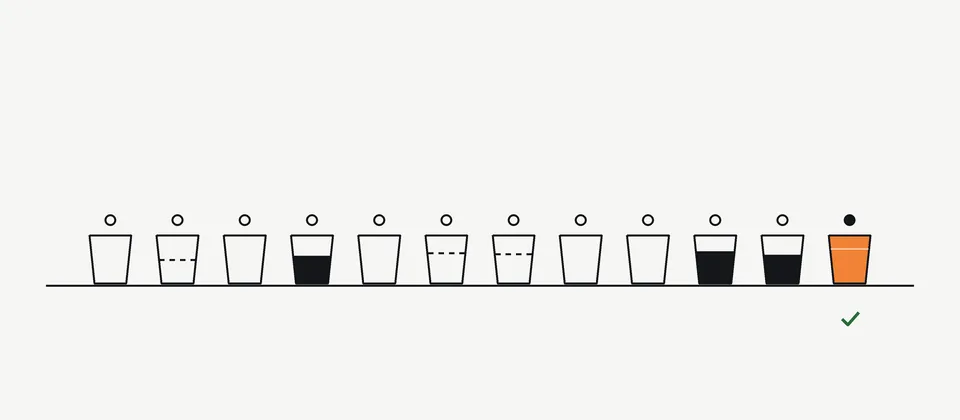
Four passes, in a fixed order, are how to rewrite AI text to human without losing what it says: facts, structure, sentences, read-back. In the 2023 study by Weber-Wulff and colleagues, hand edits to AI text cut 14 detectors' identification rate from 74 percent to 42 percent, and a machine paraphrase cut it to 26 percent, so both routes move readings; the order of the passes is what keeps the meaning while they do. This page is the procedure. The 20 individual edits are listed in the manual humanizing guide, and the tools that do the sentence pass for you are explained in the AI to human text converter guide.
Check your institution's AI policy before using any writing tool. A humanizer does not make undisclosed AI use acceptable, and this site does not help anyone misrepresent authorship.
What makes AI text sound like AI in the first place?
A rewrite only works if it changes what readers and detectors are reacting to. Three things cover most of it, and all three can be fixed by a person with a pen.
| What reads as AI | What is happening in the text | Who describes it |
|---|---|---|
| Nothing a person would have added | No specific fact, name, date, number or firsthand detail; every sentence could be about any instance of the topic | Liang and colleagues tie low perplexity, the predictability of word choice, to detector flags; a real detail is an unpredictable word |
| Even rhythm | Sentences of similar length, each with the same shape: claim, elaboration, link | Turnitin lists "content without a lot of structural variation" among the patterns behind false positives |
| Framing that carries no information | An opener that announces the topic, a closer that restates it, transitions that signal rather than say | Turnitin also names "text that literally repeats itself" and paraphrase that develops no new ideas |
Turnitin's FAQ on its AI writing detector names those patterns directly as sources of false positives on human writing, which is the useful inversion: the same patterns in AI text are what a rewrite has to remove (Turnitin, AI writing detection FAQ, read 9 November 2026). Sounding human is not a tone. It is the presence of information and variation that a model, predicting the likeliest next word, does not produce on its own.
How do you rewrite AI text to human in four passes?
Do the passes in order. The first adds what a tool cannot; the last catches what any rewrite breaks.
| Pass | What you do | What it changes | Meaning risk |
|---|---|---|---|
| 1. Facts | Add one specific fact, name, date, number or firsthand observation to every paragraph; delete any sentence that would be true of any topic | Predictability: a checked detail is a word no model would have chosen | Low, if the fact is checked |
| 2. Structure | Put the point of each paragraph in its first sentence; cut the opener and closer; make one sentence in three noticeably shorter or longer than its neighbours | Even rhythm and empty framing | Medium: a moved qualifier can detach from its claim |
| 3. Sentences | Rewrite each remaining sentence in the words you would use aloud; replace a near-synonym with the plain word, not another synonym | Word choice | Medium: a technical term swapped for a plain word can change the claim |
| 4. Read-back | Read the result against the original, sentence by sentence; restore every dropped qualifier, shifted number and changed term; then read aloud | Nothing; it catches what passes 1 to 3 broke | None; this pass removes risk |
Pass 1 is where the evidence favours the hand over the tool. In the Weber-Wulff study, the manually edited texts were ones where a person had exchanged "some words with synonyms or reordering sentence parts", and that alone brought identification from 74 percent to 42 percent across 14 tools (Weber-Wulff et al. 2023, International Journal for Educational Integrity, read 9 November 2026). Those were pass 2 and 3 edits. A pass 1 edit, adding a fact the model never had, is the one a paraphraser cannot make, and it is the one that makes the text worth reading.
What does a four-pass rewrite look like on one paragraph?
A constructed example, 60 words of typical model output about a bakery, taken through the passes. The facts added are illustrative.
| Stage | Text |
|---|---|
| Original AI text | Small bakeries face numerous challenges in a competitive market. Rising ingredient costs, changing consumer preferences, and increased competition all play a role. However, many bakeries have found success by focusing on quality and community engagement. By building strong relationships with customers, they can create loyalty that sustains them through difficult times. |
| After pass 1 (facts) | Small bakeries face numerous challenges. Flour cost us 38 percent more in 2025 than in 2022, oat milk now outsells dairy at the counter, and two chains opened within a mile. Many bakeries have found success by focusing on quality and community engagement. Our Saturday sourdough class has run 140 weeks straight. |
| After pass 2 (structure) | Flour cost us 38 percent more in 2025 than in 2022. Oat milk now outsells dairy at the counter, and two chains opened within a mile. What kept the shop open was the Saturday sourdough class, which has run 140 weeks straight, and the customers who came back from it on weekdays. |
| After pass 3 (sentences) | Flour costs us 38 percent more than it did three years ago. Oat milk outsells dairy at the counter now. Two chains opened within a mile. The shop is still here because of the Saturday sourdough class, 140 weeks and counting, and the people who take it and then come in on a Tuesday. |
| Pass 4 (read-back) | Check: "three years ago" matches 2022 against 2025; the 140 weeks survived; "sustains them through difficult times" was dropped as framing, not as a claim. Nothing to restore. |
Word count fell from 60 to 56 and the number of concrete facts rose from zero to five. Every sentence in the final version is one the owner could be asked to prove, which is the practical test of whether a text sounds human: a reader could check it.
Where does a rewriter tool fit in the four passes?
In pass 3, and only there. A humanizer or AI rewriter is a paraphrasing model, and paraphrasing is the sentence pass done at speed. Krishna and colleagues built one such model in 2023 and showed it could cut a detector's identification rate from 70.3 percent to 4.6 percent while, by their automatic measures, keeping the input's meaning; the same paper then showed a retrieval defence that caught the paraphrases by matching them to stored model outputs (Krishna et al. 2023, arXiv, read 9 November 2026). A tool can do pass 3 on 3,000 words in seconds. It cannot do pass 1, because it has no facts you did not give it, and it will not do pass 4, because it has no idea what you meant.
| Pass | By hand | By tool |
|---|---|---|
| 1. Facts | The only way | Not possible; the model has no information you did not paste |
| 2. Structure | Deliberate and checkable | Partly, as a side effect of reordering; the opener often survives |
| 3. Sentences | Slow on long texts | Fast; this is what the tools sell |
| 4. Read-back | Essential | Not offered by any tool this site has reviewed |
If you use a tool for pass 3, run the lightest mode first, paste one section at a time, and keep the original open for pass 4. The difference between a humanizer and a plain paraphraser, and why the paraphraser is often the safer choice for pass 3, is set out in humanizer vs paraphraser. No detector score should be the only evidence in a misconduct case, and no detector reading should be the only check on a rewrite; the read-back is.
How do you know when the rewrite is done?
When three things are true. Every paragraph contains at least one fact a reader could check. No sentence could be moved to another article about the same topic without change. And the original and the rewrite make the same claims with the same qualifiers, which you know because you read them side by side. Detector readings are a fourth check, not a finish line: run two detectors you do not pay a vendor for, note the date, and expect the numbers to differ. The rest of the series, including the tools compared on the same fields and the full humanizer ranking, is on the guides hub.
Sources
Questions about this guide
How do I rewrite AI text to sound human?
In four passes: add the facts, names and numbers only you know; restructure so the point comes first and sentence lengths vary; then rewrite sentence by sentence in words you would say aloud; then read the result against the original and restore anything that changed.
What makes text sound like AI?
Predictable word choice, even sentence lengths, framing openers and closers that carry no information, and paraphrase that adds nothing: Turnitin names structural sameness and repetition among the patterns that produce false positives, read 9 November 2026.
Is rewriting AI text by hand better than using a rewriter tool?
By hand changes less on detectors but risks less meaning: in the 2023 study by Weber-Wulff and colleagues, hand edits left 42 percent of AI texts identified and a machine paraphrase 26 percent, and only the hand edits added information a detector cannot predict.
How long does it take to rewrite AI text to human?
Roughly the time it takes to read the text three times with a pen: the fact pass and structure pass are the slow ones, and the sentence pass goes faster once the first two are done; a 500-word passage is a twenty-minute job for most writers.
Can a rewriter make AI text undetectable?
No: Krishna and colleagues cut one detector from 70.3 to 4.6 percent with a paraphraser in 2023 and showed in the same paper a retrieval defence that caught the paraphrases, and detectors have trained against rewrites since.
Should I rewrite AI text to human for an assignment?
Only if your institution's AI policy allows the underlying AI use and you disclose it; a humanizer does not make undisclosed AI use acceptable, and this site does not help anyone misrepresent authorship.
Related reading
 Undetectable AI pricing: what each plan costs and what it buysUndetectable AI pricing read and dated: the 250-word free trial, 10,000 words a month at $9.99 or $5.00.
 How does Turnitin detect AI? The indicator explainedHow does Turnitin detect AI? Sentence scores from 0 to 1, a 20 percent display floor, a 300-word minimum, its.
 How to humanize AI text manually: a 20-edit checklistHow to humanize AI text manually: a 20-edit checklist tied to what detectors read, the five strongest AI.
 AI to human text converter: what it is, what it does, what to checkAn AI to human text converter is an AI humanizer under another name: a paraphrasing model with a request cap..
 AI humanizer vs paraphrasing tool: what is the difference?AI humanizer vs paraphrasing tool: one rewrite engine sold two ways. What each promises, what a QuillBot pass.