AI detector false positives: who gets flagged and why
Short answer
An AI detector false positive is human writing labelled as AI, and the published rates run from under 1 percent to 61.22 percent depending on who is measured. Turnitin states under 1 percent on documents with over 20 percent AI writing; Liang and colleagues found seven detectors flagged 61.22 percent of TOEFL essays by non-native English writers in 2023.
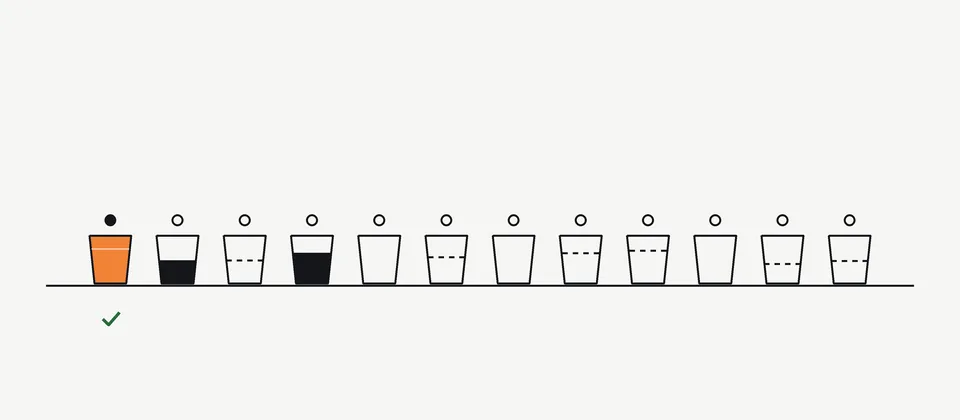
Liang and colleagues reported in 2023 that seven AI detectors flagged 61.22 percent of 91 human-written TOEFL essays as AI, the largest published false positive figure for a defined group. At the other end, Turnitin states a false positive rate under 1 percent on documents with more than 20 percent AI writing. Both numbers are true for their test sets, and the gap between them is what this guide to AI detector false positives is about: who gets flagged, why, and what the person flagged can do.
Check your institution's AI policy before using any writing tool. A humanizer does not make undisclosed AI use acceptable, and this site does not help anyone misrepresent authorship.
What is an AI detector false positive?
A false positive is human-written text that a detector labels as AI. The rate is the share of human documents so labelled. Small rates become large counts at scale, which is why one university's arithmetic in 2023 still gets quoted.
| Term | Meaning | Example from the sources |
|---|---|---|
| False positive | Human writing labelled AI | 9 percent of human text, OpenAI's retired classifier, 2023 |
| False positive rate | Share of human documents labelled AI | Under 1 percent, Turnitin, for documents over 20 percent AI |
| False negative | AI writing labelled human | Unmodified AI text identified 74 percent of the time, so 26 percent missed, Weber-Wulff et al. 2023 |
| Count at scale | Rate multiplied by submissions | 1 percent of 75,000 papers a year is about 750, Vanderbilt's 2023 estimate |
Vanderbilt University made that calculation when it switched off Turnitin's AI detector in August 2023: Turnitin claimed a 1 percent false positive rate at launch, Vanderbilt had submitted 75,000 papers in 2022, so around 750 student papers a year could have been wrongly labelled as partly AI written (Vanderbilt University, guidance on AI detection, 16 August 2023, read 9 November 2026). The post also cited the lack of insight into how the tool worked and the reports of non-native speakers being flagged.
What do vendors publish about AI detector false positives?
Every vendor figure below is the vendor's own, on the vendor's own test set; the independent figures come from 2023 studies.
| Source | False positive figure | Measured on | Read |
|---|---|---|---|
| Turnitin | Under 1 percent, documents with over 20 percent AI writing | Over 700,000 academic papers written before ChatGPT | 9 November 2026 |
| GPTZero | Average error rate under 1 percent for high-confidence predictions; 1.1 percent on TOEFL texts | Internal evaluation set | 9 November 2026 |
| OpenAI (retired) | 9 percent | OpenAI's "challenge set" of English texts | 9 November 2026 |
| Weber-Wulff et al. 2023 | 0 percent (Turnitin) to 50 percent (GPTZero) | Nine human-written documents per class across 14 tools | 9 November 2026 |
| Liang et al. 2023 | 61.22 percent average across seven detectors | 91 TOEFL essays by non-native writers | 9 November 2026 |
Turnitin states it keeps the rate "under 1% for documents with over 20% of AI writing", that it tests on over 700,000 pre-ChatGPT papers before each release, and that it does not display scores below 20 percent in the report (Turnitin, AI writing detection FAQ, read 9 November 2026). GPTZero states that its de-biasing work since April 2022 has reduced the false positive rate on TOEFL texts to 1.1 percent (GPTZero, technology page, read 9 November 2026). The gap between GPTZero's 1.1 percent and Weber-Wulff and colleagues' 50 percent is three years of model updates and two different test sets, which is the point: a false positive rate is a property of a detector, a text set and a date, never of detectors in general.
The guide on whether AI detectors work covers accuracy in both directions; this page stays with the human writers who get flagged.
Who gets flagged most?
The pattern in the published evidence is that detectors flag writing that is plain, even and predictable, whoever wrote it.
| Group or text type | Evidence | Who reported it |
|---|---|---|
| Non-native English writers | 61.22 percent of TOEFL essays flagged on average; 89 of 91 flagged by at least one detector; essays all seven flagged had significantly lower perplexity | Liang et al. 2023 |
| Writers of formulaic or repetitive prose | Named as a false positive source: "content without a lot of structural variation, text that literally repeats itself" | Turnitin FAQ |
| Writers who paraphrase without adding ideas | Named as a false positive source | Turnitin FAQ |
| Writers of very predictable text | "Text that is very predictable cannot be reliably identified" | OpenAI 2023 |
| Short texts | "Very unreliable on short texts (below 1,000 characters)" | OpenAI 2023 |
| Human text translated by machine | Accuracy on human text fell by 20 points after machine translation | Weber-Wulff et al. 2023 |
Liang and colleagues went a step further and showed the mechanism. When they prompted a chatbot to enrich the vocabulary of the TOEFL essays, the average false positive rate fell from 61.22 percent to 11.77 percent, and when they asked it to simplify the US essays as a non-native speaker might, the flags rose (Liang et al. 2023, Patterns00130-7), read 9 November 2026). The detectors were not reading authorship; they were reading vocabulary range.
That finding sits behind the fairness objection to detectors in education. A student writing in a second language, or a first-year writing to a template, produces exactly the text the models were trained to call machine made.
What do the detector makers say a score is?
The vendors' own guidance is the strongest material a wrongly flagged writer has. Turnitin states that its percentage "should not be used as the sole basis for action or a definitive grading measure by instructors" and that it "provides data for the educators to make an informed decision" (Turnitin, AI writing detection FAQ, read 9 November 2026). GPTZero's FAQ states that "these results should not be used to punish students" and recommends a holistic assessment of student work (GPTZero, FAQ, read 9 November 2026). OpenAI wrote that its classifier "should not be used as a primary decision-making tool" (OpenAI, new AI classifier, read 9 November 2026).
No detector score should be the only evidence in a misconduct case.
Weber-Wulff and colleagues put the problem from the student's side: detectors return a statement like "likely written by AI" without any possibility of verification or evidence, so "a student accused of unauthorised content generation only on this basis would have no possibility for a defence" (Weber-Wulff et al. 2023, International Journal for Educational Integrity, read 9 November 2026).
What should you do if you are flagged?
The full procedure is on the page about what to do if you are flagged for AI. The short version: ask which detector, what reading and what date; collect your drafts, version history, notes and sources; quote the vendor's own statement that a score is not a sole basis for action; and ask for the review process your institution's policy sets out. Do not run your own writing through a humanizer to "fix" a flag; that creates the problem the detector was built for.
For Turnitin specifically, the Turnitin evidence page collects what Turnitin has published, including the 20 percent display threshold and the 300-word minimum, so you can check whether a reported figure is even one the tool would show.
How does this site measure false positives in its own tests?
The published method runs six human-written control texts, one per genre, through the same five detectors as every humanizer output, on the same day, so each detector's false positive behaviour is visible beside its readings of AI text. The controls were written by the editors for the test set and never published elsewhere. Those rows are the only false positive figures this site will ever state as its own; every other number on this page belongs to the study or vendor named beside it. The guides hub holds the rest of the series.
Sources
Questions about this guide
What is the false positive rate of Turnitin's AI detector?
Turnitin states under 1 percent for documents with over 20 percent AI writing, validated on over 700,000 pre-ChatGPT academic papers, and does not display scores below 20 percent; Vanderbilt noted in 2023 that 1 percent of its 75,000 yearly submissions would be about 750 papers.
Does GPTZero have false positives?
Yes, and it publishes figures: an average error rate under 1 percent for its high-confidence predictions on an internal set, and a 1.1 percent false positive rate on TOEFL texts after de-biasing, both read on 9 November 2026; Weber-Wulff and colleagues measured 50 percent on their human documents in 2023.
Why are non-native English writers flagged more often?
Because detectors score word predictability: Liang and colleagues found the flagged TOEFL essays had significantly lower perplexity, and a prompt enriching the vocabulary cut the average false positive rate from 61.22 to 11.77 percent.
What kinds of human writing trigger AI detectors?
Turnitin names text without much structural variation, text that literally repeats itself, and paraphrase that develops no new ideas; OpenAI added very predictable text and anything under 1,000 characters.
What should I do if I am falsely accused of using AI?
Ask for the detector name, the exact reading and the date, gather your drafts, version history and notes, point to the vendor's own statement that a score is not proof, and ask for the review your institution's policy provides; this site has a step-by-step page.
Can a false positive be proven wrong?
Not from the score alone, since a detector reports a probability without evidence; a writer can show process, through drafts and edit history, which is why Weber-Wulff and colleagues wrote that a student accused on a score alone would have no possibility for a defence.
Related reading
 AI detectors and TOEFL essays: why non-native writers get flaggedAI detector TOEFL essays: Liang 2023 found 61.22 percent of human TOEFL essays flagged as AI, why it happens.
 AI humanizer for Google Docs: the two ways to do it and what the document keepsAI humanizer for Google Docs: three Chrome extensions name Docs in their store listings, read 9 November.
 Do AI detectors work?Do AI detectors work? What a 2023 test of 14 tools found, what OpenAI, Turnitin, GPTZero and Pangram publish.
 Falsely accused of using AI? What to do, step by stepFalsely accused of using AI? The evidence to gather, drafts, version history and notes, what Turnitin and.
 AI humanizers and Turnitin: what the evidence showsBest AI humanizer for Turnitin, answered with evidence: what Turnitin states it detects, its stated false.